> For the complete documentation index, see [llms.txt](https://docs.igenius.ai/llms.txt). Markdown versions of documentation pages are available by appending `.md` to page URLs; this page is available as [Markdown](https://docs.igenius.ai/crystal-advisor/analyze-your-data/alerts.md).
# Alerts
This page gives an overview of the Alerts capability.
Alerts
By nature, **data changes over time**.
For this reason, in order to have a clear understanding of data, it is crucial to capture all its changes and fluctuations.
Of course, Crystal can do this for you!
Crystal is able to **monitor** data fluctuations, in order to **spot relevant events** and to **warn you about them** through an **"Alert"** notification, in the case of an unexpected event.
All you have to do is **select a Topic** of interest and activate it by **choosing a specific kind of Alert** from the options available.
Alerts are useful to stay **constantly** **updated, informed, and in control** of your data, without the need to worry about searching manually.
Here's an overview of the Alerts available and how to use them.
## Alert Types
There are three types of Alert options on Crystal. Each of them correspond to **specific Data Analysis techniques** that can be applied on the chosen Topic.
### **Anomaly Detection**
{% hint style="success" %} **Pills of Data Analysis**
Anomaly Detection is a Data Analysis technique used to **identify patterns or occurrences that deviate** significantly from the usual or expected behavior of the given dataset.
Some types of anomalies can be **errors**, **outliers**, or **unusual patterns**.
{% endhint %}
You can use this type of Alert when you don’t have a specific data change in mind but want to *keep an eye* *on* a specific Topic in general.
After setting this type of Alert, Crystal’s expertise will determine which kind of anomaly can be found, among several types of anomalies possible.
### **Threshold Monitoring**
{% hint style="success" %} **Pills of Data Analysis**
This type of Data Analysis focuses on **catching the exact moment** when a **value goes** **above or below a specific threshold**.
{% endhint %}
Using this type of Alert is most appropriate when you *need to monitor how a specific Topic value behaves in comparison to a specific threshold value -* if and when it goes below or above it.
When you set this type of Alert, you can decide the direction of the analysis and the threshold value.
### **Topic Scheduling**
{% hint style="success" %} **Pills of Data Analysis**
This type of Data Analysis is focused on **obtaining instant** **snapshots** of data at **specific** **moments in time**.
{% endhint %}
Using this type of Alert is most appropriate if you need to be notified on a Topic in order to *compare its status at different moments in time*.
When you set this type of Alert, you can decide when and how often you should receive the reports you're programming.
## **Set an Alert**
In general, there are two alternative methods to set Alerts:
* By asking Crystal in a **Conversation** (textual or vocal)
* By setting it from the **Topic Card** of a selected Topic (clicking on the relative icon)
{% hint style="info" %} **Please Note**
As of now, different kinds of Alerts support different activation methods.
You can find a recap in the following table.
{% endhint %}
| Alert Type | Conversational Method | Topic Card Method |
| ------------------------ | ------------------------------------- | ------------------------------------- |
| **Anomaly Detection** | Yes | Yes |
| **Threshold Monitoring** | Yes | No |
| **Topic Scheduling** | No | Yes |
{% hint style="warning" %} **Remember**
* Currently, the maximum amount of Alerts that you can set is *20:* 10 Anomaly Detections and 10 Topic Scheduling
* Threshold Monitoring counts as an Anomaly Detection
* The Topic Card method applies to both [*Configured Topics*](/crystal-console/topics-configuration.md) and [*Auto-generated ones*](/crystal-advisor/talk-to-your-data/conversation/request-topics/entity-based-conversation.md), whereas the Conversational method applies to Configured Topics only
{% endhint %}
## **Manage Active Alerts**
After setting your Alerts, you can always check and manage them as you need.
All of your **Active Alerts** can be found in the **Alert Section**, accessible from your **Account,** as follows:
1. Open the *Account Section*
2. Open the *Alert Section,* where you'll see the total number of Active Alerts at a glance
Steps 1, 2
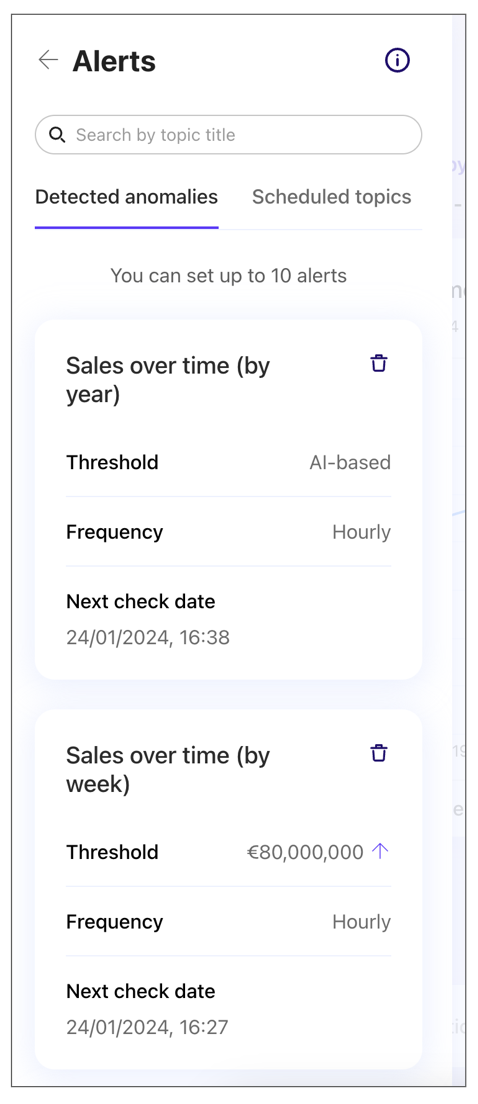
3. [**Check** your Alerts. You can find the full list of Active Alerts and all the relative settings and details (e.g. threshold values, frequencies of occurrence, etc.)](#user-content-fn-1)[^1]
{% hint style="info" %} **Please Note**
Alerts are divided between Anomaly Detection (which also includes Threshold Monitoring) and Topic Scheduling.
{% endhint %}
4. **Search** for your Alert. If you want to quickly find a specific Alert, you can use the Search Bar
5. Finally, you can **delete** Alerts by clicking on the corresponding icon within the selected Alert Card. A pop-up will appear to confirm that you want this Alert deleted.
Steps 3, 4, 5
{% hint style="info" %} **Please Note**
At the moment, it is not possible to **edit** Alerts yet.
If you need to modify an existing Alert, please delete it first and create a brand new one.
{% endhint %}
## **Receive an Alert Notification**
When an event of interest takes place or if a scheduled time has come, Crystal will send you a notification about it. Just click on it to discover what happened!
This way, you will always be **updated on your data in real time** and you will be able to **quickly** **adapt your decisions to the turns of events**.
{% hint style="warning" %} **Remember**
If you are using the Crystal app, be sure to turn on push notifications, so that you don't miss any Alerts.
{% endhint %}
Now, let's dive deeper, with a concrete example. Choose an Alert of your interest to see the full experience!
***
## Deep-Dive!
{% content-ref url="/pages/oe44rZtFVyiw4UZJa2kZ" %}
[Anomaly Detection](/crystal-advisor/analyze-your-data/alerts/alerts.md)
{% endcontent-ref %}
{% content-ref url="/pages/CD5ZzNoI5bDXmDmCH5XU" %}
[Threshold Monitoring](/crystal-advisor/analyze-your-data/alerts/alerts-1.md)
{% endcontent-ref %}
{% content-ref url="/pages/WwyEJ6ayjyCfEWNVPwwa" %}
[Topic Scheduling](/crystal-advisor/analyze-your-data/alerts/alerts-2.md)
{% endcontent-ref %}
[^1]: suggestion: let's delete this, the part about the details can be added in 2. what do you say?